How to Use Flashcards for Language Learning
Learn how to build vocabulary flashcards with useful context, pictures, and focused prompts instead of memorizing isolated word lists.
Posted by
 SwiftStudy Team
Related reading
How to Make Effective Flashcards
A practical guide to writing clear flashcards that test one idea, encourage active recall, and stay useful as you learn.
Active Recall with Flashcards: A Simple Study Routine
Use flashcards for active recall with a repeatable routine for exams, definitions, formulas, and other material you need to remember.
Learn words in usable context
A word-to-word translation is a good starting point, but it often leaves out the information you need in a real conversation. Add a short example, a grammatical clue, or a situation that makes the intended meaning unambiguous. For nouns, include the article when the language uses grammatical gender. For verbs, write the form you actually want to recall.
Build several kinds of vocabulary card
- Target language → meaning, to practise recognition.
- Meaning or picture → target language, to practise production.
- Sentence with a blank → missing word, to practise usage.
- Similar words → the difference between them, to prevent mix-ups.
You do not need every variation for every word. Choose the direction that matches your goal. If you want to speak or write, include cards that make you produce the target language rather than only recognize it.
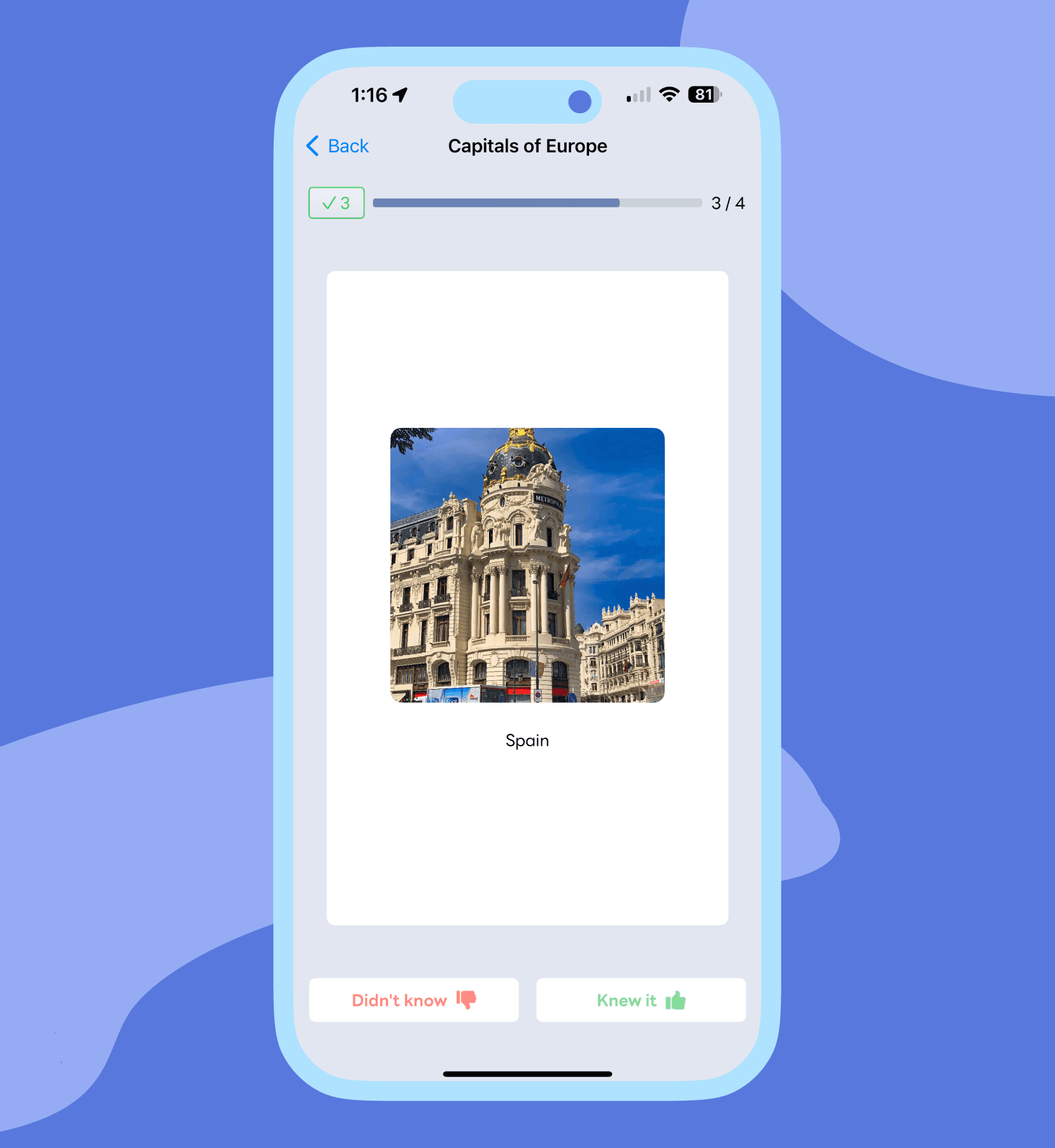
Let pictures replace unnecessary translation
Concrete nouns, places, actions, and visual distinctions can often be learned directly from a picture. That creates a useful association without routing every answer through your first language. SwiftStudy supports picture cards and custom stacks for each course, theme, or level. Explore the dedicated language-learning flashcard features.
Review a little, then use the language
Flashcards are a retrieval tool, not the whole language-learning process. Pair them with reading, listening, conversation, and writing. When you encounter a useful word in the wild, add a card using the same context. That keeps your deck connected to the language you genuinely want to understand.